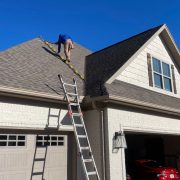
Leaves, Gutters, and Your Fascia: A Fall Roof Checklist

Your Fall Roof Checklist
1. Clean out your gutters (once most of the leaves are down)
When gutters fill with leaves, rainwater has nowhere to go. It spills over the front, or worse, backs up behind the gutter and soaks into the fascia board and the edge of your roof deck. A gutter packed with wet leaves is also heavy enough to pull its hangers loose.
Timing matters. If you clean in mid-October and the oaks drop the rest of their leaves in November, you’ll be doing it twice. While you’re at it, run a hose through each downspout to make sure water flows freely and drains away from your foundation.
2. Look closely at your fascia and soffits
The fascia is the board your gutters hang on, and it takes a beating when gutters overflow. From the ground, look for peeling paint, dark water stains, sagging gutter runs, or boards that look swollen or warped. Soft or crumbling wood usually means rot has already set in. (We covered the warning signs in more detail in our post on wood rot and fascia damage.)
Check your soffits too. Fall is when squirrels and raccoons go looking for a warm place to spend the winter, and a small gap in a soffit is an open invitation into your attic that you don’t want to extend.
3. Check the flashing around chimneys, vents, and skylights
Flashing is the metal that seals the joints where your roof meets a chimney, vent pipe, skylight, or wall. When it lifts, cracks, or pulls away, water gets in. You don’t always need to climb up to check it. A pair of binoculars from the yard will show you bent metal, gaps, or cracked sealant.
These spots are where most roof leaks begin. For a closer look at each one, read Where Roof Leaks Start: A Homeowner’s Guide to Roof Penetrations.
4. Look for lifted, cracked, or missing shingles
Fall wind storms are hard on shingles, especially older ones. Walk around your house and look for shingles that are missing, curled at the edges, cracked, or sitting at an odd angle. When you clean your gutters, notice whether they’re full of shingle granules (they look like coarse dark sand). A lot of granules means your shingles are wearing out.
5. Clear leaves out of your roof valleys
Valleys are the channels where two roof slopes meet, and they carry more water than any other part of your roof. Leaves and pine needles pile up there, hold moisture against the shingles, and slow drainage. Over a winter, that trapped debris can wear down shingles and lead to leaks.
6. Trim branches hanging over your roof
Overhanging branches scrape shingles in the wind, drop extra leaves into your gutters, and give squirrels a bridge onto your roof. They can also snap under the weight of ice that we always expect in a St. Louis winter. Keep limbs trimmed back several feet from the roofline.
7. Take a quick look in your attic
Your attic often shows roof problems before your ceilings do. On a sunny afternoon, look for daylight coming through the roof boards, water stains on the wood, damp or matted insulation, or a musty smell. Any of those means it’s time for a professional to take a closer look.
Leave the Climbing to Us
Everything on this list can be checked from the ground, a ladder at the gutter line, or inside your attic. Walking on a roof covered in wet leaves is a good way to get hurt, so leave anything on the roof itself to a crew with the right gear.
Call a roofer before winter if you notice:
- Soft, stained, or sagging fascia
- Missing, curled, or cracked shingles
- Gutters full of granules
- Lifted or rusted flashing
- Water stains, damp insulation, or daylight in the attic
A problem that costs a small repair in October can turn into a ceiling leak in January.
Get Your Roof Ready Before the First Freeze
1st Choice Roofing and Construction is based right here in Arnold, and we inspect roofs across the St. Louis Metro area. If your fall walk-around turned up anything that worries you, or you just want a second set of eyes before winter, give us a call at 636-282-0090 to schedule an inspection.